
Project Date
February 16, 2025
This monitoring system was developed by RST Ltd. to address public-safety issues and state-compensation disputes arising from disasters such as roadside tree collapse, slope sliding, and rockfall.
Purpose and Monitoring Targets
The system’s monitoring targets include roadside trees and potentially hazardous areas subject to slope sliding, structural failure, and rockfall. It provides instrumented observation specifically for the loss of mechanical support strength caused by tree diseases — such as brown root rot — that are difficult to detect from external appearance.
Sensing and Equipment
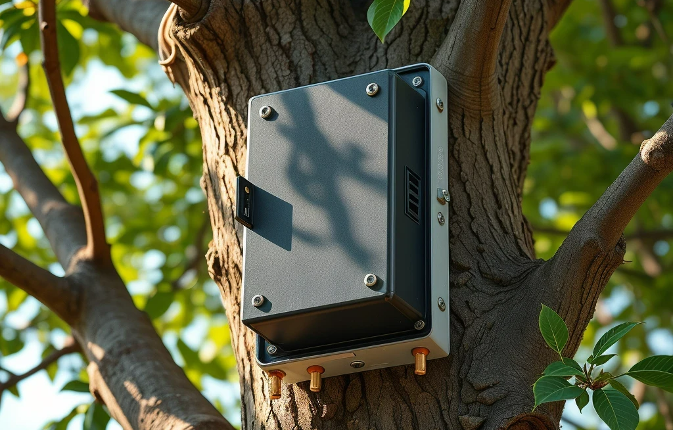
At the core of the sensing hardware is a high-precision accelerometer (G-sensor) that calculates tilt to monitor changes in a tree’s mechanical support strength before it falls. The system also integrates temperature, humidity, and barometric pressure sensors, along with GNSS and a power system (battery with expandable solar panel), to assess tree health, determine location, and monitor device status.
Data Transmission and Deployment
Sensors transmit data via Bluetooth to a Gateway (receiver), which then relays the data to the cloud over a 4G network. Within the deployment area, sensors can be arranged along a line to form a mesh network, with a transmission range of approximately 20–100 meters.
Data Processing and Database System
The system adopts a highly resilient, highly scalable hybrid-cloud architecture:
- Public Cloud: Data reception, high-resilience computation, and high-performance processing such as hexadecimal conversion are handled via VULTR cloud servers and Cloudflare Workers, ensuring uninterrupted service — data continues to be received and processed even during power outages.
- Private Cloud: Sensitive data is stored in a MariaDB database and paired with RST’s own data center, achieving tiered secure data storage and disaster-recovery backup capability.
- Alert mechanism: Real-time monitoring and alerting is implemented using Grafana dashboards and a LINE Bot, notifying relevant personnel immediately of any anomaly.
Early-Warning Mechanism
The system issues warnings by analyzing three-axis acceleration data, including vibration and tilt signals. Warning criteria include:
- The theoretical value of the three-axis resultant vector is 1g, used to assess whether the tree is being affected by external force.
- If the angle between any axis and the resultant vector, or the plane’s pitch and roll angles, exceeds 1 degree, this indicates possible tilting and triggers a warning.