The value of geotechnical and structural monitoring lies in being “always on” — slopes, bridges, and dams don’t wait for business hours to move, and earthquakes are a matter of seconds. So the most important thing about a monitoring platform is often not how many features it has, but whether it can run around the clock, never lose data, and be available whenever you need it. Below, five design choices explain how the GeoGuard data platform achieves long-term stable operation — without diving into technical detail, focusing only on what truly matters to your monitoring results.
1. Built on a Global Edge Cloud, With No Single Point of Failure
The traditional approach puts a system on a single server or in a single data center — and the moment it crashes, loses power, or loses network, the entire monitoring operation stops with it. GeoGuard’s computation runs distributed across nodes on a global edge cloud network, so no single machine is one that “must never fail.” If an individual node has a problem, traffic is automatically taken over by other nodes, and the service keeps running.
2. From Sensor to Cloud, No Bottlenecks and No Data Loss
Data from field sensors (GNSS, accelerometers, inclinometers, and so on) is first received safely by a front-end receiver, then handed off to the cloud for processing — “receiving” and “processing” are two separate stages, buffered by a queue in between. This means that even if data surges in an instant (an earthquake striking, or many stations reporting at once), the data is first safely buffered and processed in turn, rather than overwhelming the system or being dropped. In monitoring, “not a single record can go missing” is a baseline requirement.
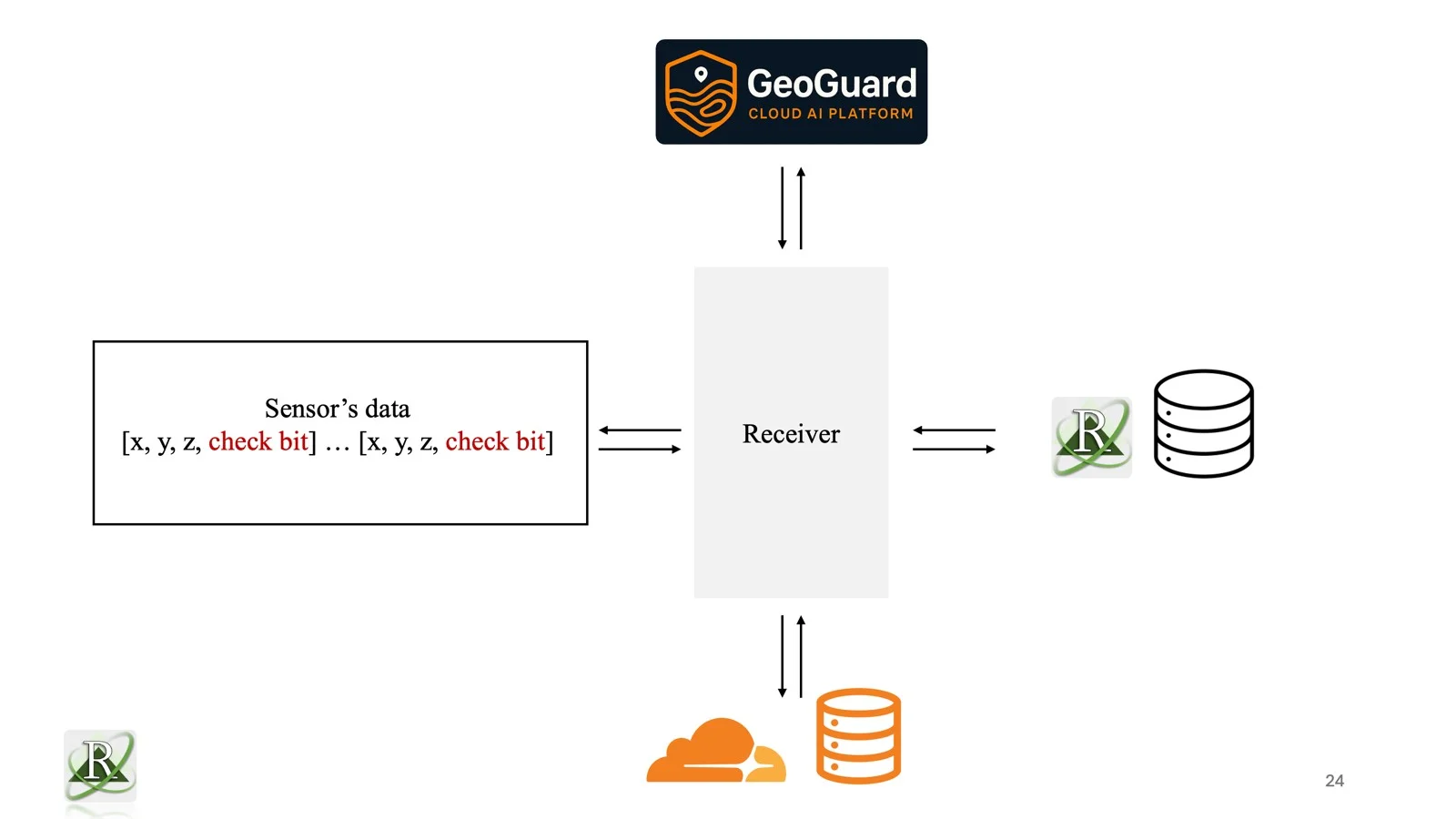 *Sensor data carries a check bit; it is first received and buffered safely by the Receiver, then handed to the GeoGuard Cloud AI Platform for computation while being written to the database and Cloudflare edge cloud — ensuring data is never bottlenecked, never lost, and always verifiable.*
3. Scales Automatically With Events
In normal times the volume of monitoring data is steady and the system stays lean; the moment an event peak arrives (a strong earthquake, heavy rain, or many projects alerting at once), computing resources scale up automatically to absorb the surge, then scale back down once the event passes. You don’t have to keep a fleet of idle servers running all year “just in case,” and the system won’t stall for lack of compute at the most critical moment.
4. We Monitor Ourselves by the Same Standard
The last thing that should happen to a monitoring company is “our own system went down and we didn’t know.” GeoGuard applies the same real-time health monitoring to its own operation: anomalies trigger automatic alerts and immediate response, and the system’s operating status is published on an independent status page. We ask that our customers’ structural safety be watched 24 hours a day — and we watch our own system by exactly the same standard.
5. Every Update Is Verified Automatically Before Going Live
The platform keeps improving and adding features, and “updates” are often the highest-risk moment for a system to break. Before every change goes live, GeoGuard automatically runs a set of critical checks — in particular, whether different customers’ data is truly isolated from one another, and whether data stays complete and untampered in transit. If those baseline tests don’t pass, the change cannot reach production. Stability isn’t luck; it’s every update being gatekept by machines.
Stability Is a Monitoring System’s First Feature
However beautiful the charts or however clever the AI analysis, they all rest on one premise: “the system must always be there, and the data must always be right.” GeoGuard puts stability first in its architecture — no single point of failure, no data loss, scaling with events, self-monitoring, and automated gatekeeping of updates — so that the monitoring platform itself is worthy of trust.
FAQ
Q: Will the whole system go down if one server fails? No. Computation is distributed across a global edge cloud network, with no single fatal node; if an individual node fails, others automatically take over and the service keeps running.
Q: When data surges during an earthquake or heavy rain, will it bottleneck or be lost? “Receiving” and “processing” are separated and buffered by a queue, so surges are safely buffered and processed in order, while compute scales up automatically to absorb the peak — data is not lost.
Q: How do I know whether the system is running normally right now? GeoGuard publishes its operating status on an independent status page you can check anytime, and anomalies also trigger automatic alerts.
Want to learn more about how the GeoGuard data platform safeguards your monitoring project? Feel free to contact RST Ltd..